

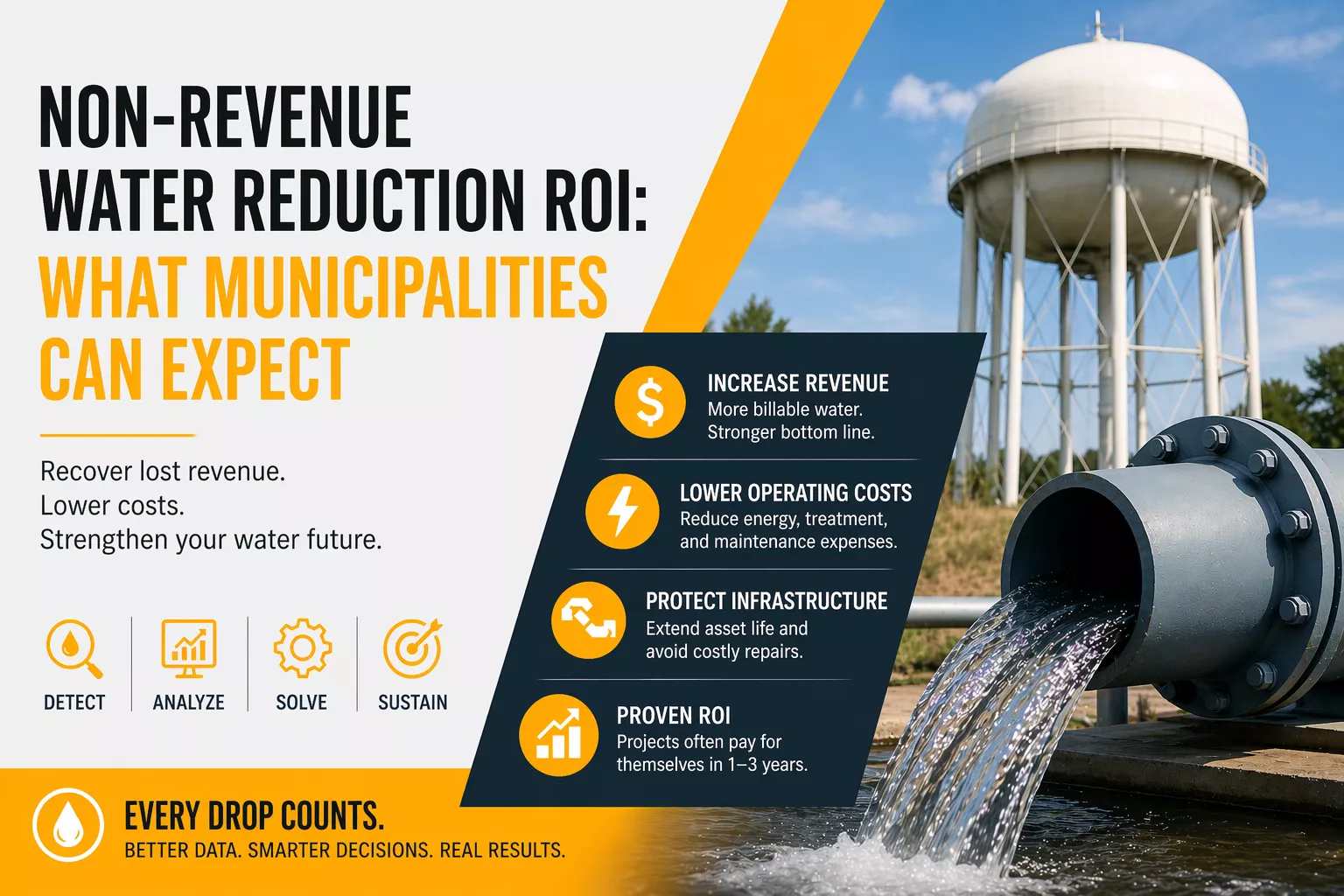
Water Loss Is Quietly Draining Municipal Budgets
Every day, municipalities across Texas lose thousands, even millions, of gallons of treated water before it ever reaches a customer.
This is known as non-revenue water (NRW) and it represents one of the most overlooked financial leaks in public infrastructure.
But here’s the real issue…
You’re not just losing water.
You’re losing revenue, energy, and operational efficiency all at the same time.
Understanding the True ROI of NRW Reduction
When municipalities begin exploring NRW reduction, one of the first questions is:
“Is it worth the investment?”
The answer is clear:
Yes, and the return often faster than expected.
Reducing non-revenue water delivers ROI across multiple areas:
1. Immediate Revenue Recovery
Every gallon of water recovered is a gallon that can either be billed (Apparent Losses) or didn’t need to be purchased/produced (Real Losses).
By identifying leaks, meter inaccuracies, and unauthorized usage, municipalities can quickly increase billable water and reduce cost, yielding net profitability increase for the department.
2. Lower Energy & Treatment Costs
Treating and pumping water requires significant energy.
When water is lost through leaks or excessive flushing, that energy is wasted.
Reducing NRW means:
- Lower electricity costs
- Reduced chemical usage
- Less strain on treatment facilities
3. Extended Infrastructure Lifespan
Undetected leaks and pressure issues accelerate wear and tear on pipes and systems.
By implementing pressure management and leak detection strategies, municipalities can:
- Reduce emergency repairs
- Extend pipe life
- Minimize costly infrastructure replacements
4. Improved Operational Efficiency
Modern NRW programs use data, monitoring, and smart technologies to provide real-time insights.
This leads to:
- Better decision-making
- Faster response times
- More efficient allocation of resources
NRW Reduction Projects Often Pay for Themselves
One of the most compelling aspects of NRW reduction is how quickly municipalities can see a return.
In many cases:
- Revenue gains begin within months
- Operational savings compound over time
- Projects can be partially or fully funded through grants and state programs
When combined with available funding opportunities, the financial barrier to entry becomes even lower.
Instead of viewing NRW reduction as an expense, forward-thinking municipalities see it as a self-funding investment that strengthens both budget and infrastructure.
The savings almost always outweigh the cost from Day 1, yielding immediate ROI to your utility.
Partner with Experts Who Deliver Measurable Results
At Holistic Utility Solutions, we specialize in helping municipalities identify, plan, and implement NRW reduction strategies that deliver real financial impact.
From water audits and system analysis to turnkey implementation, our approach is designed to:
- Maximize ROI
- Minimize disruption
- Align with available funding programs and budgets
If your municipality is ready to recover lost revenue, improve efficiency, and future-proof your water system, contact Holistic Utility Solutions today to schedule a consultation.
Here’s a final thought…
Water loss is inevitable but unmanaged loss is optional.
The municipalities that act now will not only conserve water, but they’ll unlock new revenue streams, reduce costs, and build more resilient systems for the future.