
Utilities across Texas and the other states face a common challenge which is high levels of non-revenue water (NRW), caused largely by silent, underground leaks that may go undetected for years. As the infrastructure ages, these hidden losses increase while quietly draining operational budgets, elevating treatment costs, and straining already-tight water resources.
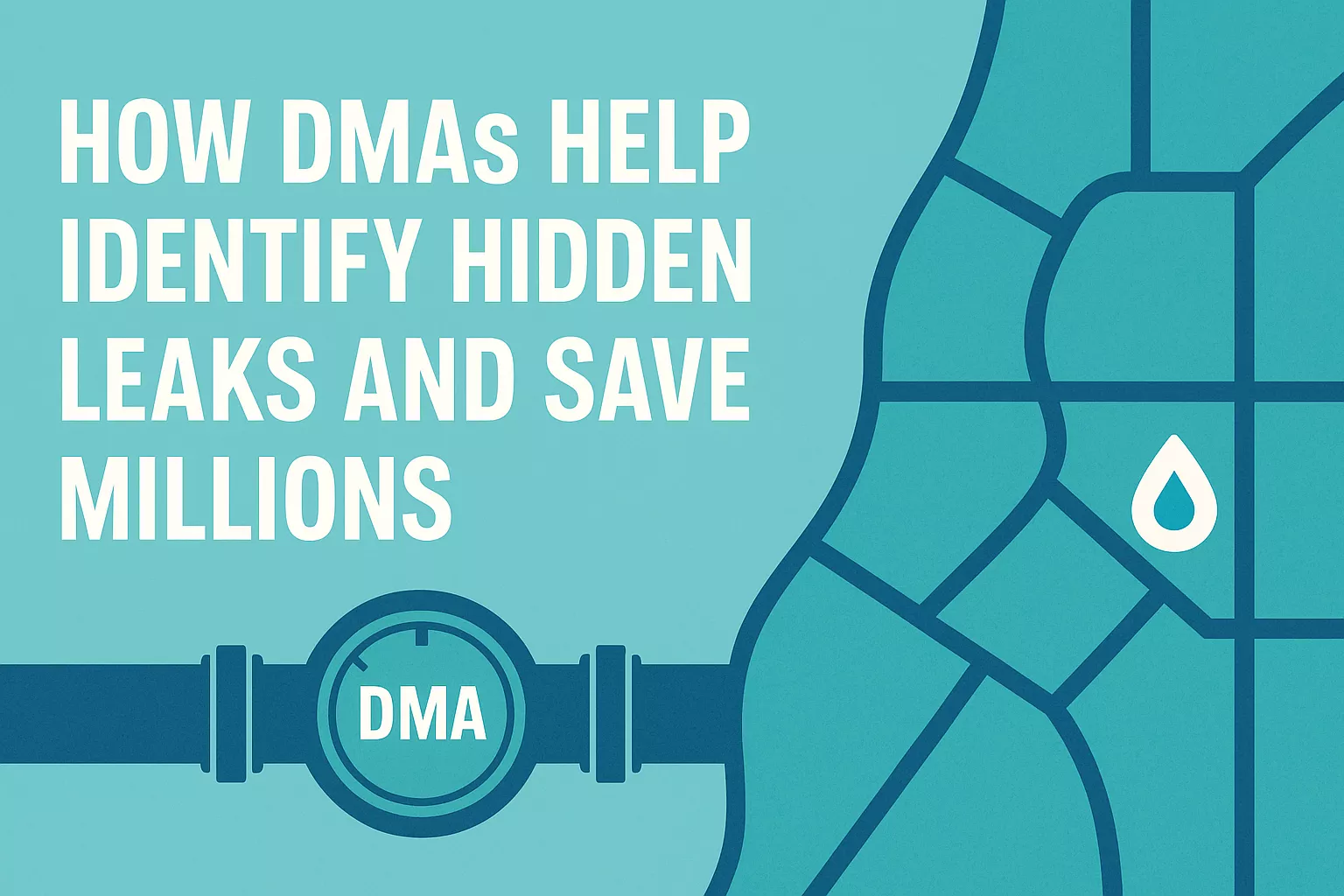
To solve this, leading utilities are adopting a modern, data-driven strategy: the District Metered Area (DMA) approach. When implemented correctly, a district metered area provides unmatched visibility into where water is lost, how much is being lost, and where to act first—often saving millions annually.
Let’s breaks down exactly how DMAs work, why they’re becoming a foundational practice in NRW reduction, and how they maximize your leak detection ROI.
Why District Metered Areas Matter Now
Aging infrastructure and rising water demand are pushing utilities to rethink old methods. Traditional systemwide leak detection is expensive, slow, and nearly impossible to maintain year-after-year.
A district metered area changes the game by breaking the network into measurable zones where anomalies pop out instantly. Instead of hunting leaks across hundreds of miles of pipe, utilities identify the exact zone, drastically narrowing the search.
Utilities that adopt DMAs report:
- 30%–60% faster leak detection
- 20%–40% reduction in NRW
- Millions saved in avoided production costs
- Improved regulatory compliance, especially for water loss reporting
This is the modernization path most utilities are taking and it starts with segmentation.
What Is a District Metered Area (DMA)?
A district metered area is a defined geographic zone within a utility’s distribution system where the inflow and outflow can be accurately measured. Each district metered area is isolated using boundary valves and equipped with:
- Inlet and outlet meters
- Pressure sensors
- Real-time telemetry
- Flow dashboards
- Alarms for abnormal consumption
This segmentation creates a closed, monitorable district, where every gallon is accounted for.
How DMAs Improve Leak Visibility
DMAs expose hidden leaks by creating a baseline of normal flow, then highlighting areas where consumption does not match expected demand.
Key benefits include:
- Night-flow analysis, the gold standard for leak detection
- Identification of slow, long-term background leaks
- Real-time alarms for sudden bursts
- Prioritization of leak investigation zones
- Reduced field time for listening crews
Instead of searching blindly, operators know exactly where to send field teams, which in turn helps improving leak detection ROI significantly.
The Financial Impact of DMA Programs
Understanding Leak Detection ROI in DMA Zones
A structured DMA plan consistently produces some of the highest ROI in utility operations. Why? Because you’re fixing the losses that matter most.
When calculating leak detection ROI, utilities consider:
- Avoided treatment and pumping costs
- Avoided electricity usage (especially in high-lift systems)
- Reduced customer outages from unreported leaks
- Fewer emergency repairs and overtime
- Life extension of infrastructure
- Better asset management data
On average, utilities see the highest ROI from:
- DMA-based leak detection
- Pressure management
- Smart meters paired with DMA flow data
- Advanced flow analytics
Utilities commonly achieve 200%–800% ROI on DMA programs within 12–24 months.
Example: DMA Savings in a 20,000-Connection Utility
- Baseline NRW: 28%
- Post-DMA implementation: 18%
- Annual water savings: 350–500 million gallons
- Annual financial savings: $1.4M–$2.1M
- Payback period: < 12 months
This is typical and not exceptional.
How to Implement DMAs Effectively
Steps to Building a High-Performance DMA Program
- Map the system and define hydraulic boundaries
- Install master meters and pressure sensors
- Validate meter accuracy (critical for data quality)
- Ensure boundary valves are functional and sealed
- Integrate telemetry and dashboards
- Build nightly minimum flow profiles from AMI data
- Create zone prioritization for leak crews
- Track leak detection ROI over 12 months
A strong DMA strategy becomes the backbone for water-loss control, asset management, and long-term capital planning.
Contact Holistic Utility Solutions About District Metered Area
Aging infrastructure doesn’t have to keep draining your budget. A well-designed district metered area program delivers long-term leak visibility, financial savings, and operational confidence.
At Holistic Utility Solutions, we employ some of the leading national experts on hydraulic modeling, District Metered Areas, water loss analysis, pressure management, and system level dashboards and analytics.
Ready to reduce NRW and boost your leak detection ROI?
Schedule your Free Water Audit Review with Holistic Utility Solutions today.