
One-Time $1.038B State Funding Opportunity for Local Water Supply & Infrastructure Projects
The Water Supply and Infrastructure Grants (WSIG) program is a one-time state grant opportunity administered by the Texas Water Development Board (TWDB) to fund water supply and water infrastructure projects across Texas municipalities and local governments. Established under House Bill 500 (HB 500) during the 89th Texas Legislative Session, this new grant program makes up to $1.038 billion in funding available exclusively for eligible water system improvements.
We will explain how the WSIG program works, who is eligible, the types of projects funded, key implementation details and what communities need to know to prepare competitive applications.
What Is the WSIG Program?
The Water Supply and Infrastructure Grants program was created through legislative appropriation of $1.038 billion to the TWDB for water supply and water infrastructure projects. Unlike traditional revolving loan funds or matching programs, WSIG provides 100% grant funding for approved projects, meaning applicants do not have to repay the awards.
Because the appropriation goes directly into the TWDB’s general revenue fund, WSIG is a standalone, one-time grant program rather than part of existing TWDB funding accounts. Funds must be committed and closed before August 31, 2027 or they will no longer be available.
Who Is Eligible for the WSIG Funding?
The program is restricted to political subdivisions and local governments in Texas. Eligible entities include:
- Cities and municipalities
- Counties
- River authorities
- Special law districts
- Irrigation and water control districts
- Groundwater conservation districts
Importantly, water supply corporations (WSCs) and investor-owned utilities are not eligible to receive these funds due to constitutional restrictions on state grants to private entities.
Project Types Funded
WSIG supports a broad range of water supply and infrastructure projects, including but not limited to:
- Correcting system deficiencies (e.g., water quality, pressure, loss)
- Upgrading or replacing aging water systems
- Expanding service to underserved areas
- Purchasing water system capacity or water rights
- Water reuse projects that expand supply
- Efficiency improvements and loss reduction initiatives
Ineligible project categories include:
- Wastewater treatment
- Flood control or drainage infrastructure
- Projects outside the defined scope of water supply and infrastructure
Key WSIG Program Details
Grant Structure
WSIG funds are distributed as 100% grants and will not be leveraged with bonds or loans. This enables faster cash outlays to communities with priority infrastructure needs.
Eligibility & Requirements
Eligible applicants must meet the following conditions:
- Be a political subdivision or eligible local government.
- Submit a complete application including a recent audited financial statement (2025 fiscal year-end).
- Ensure project consistency with the 2027 State Water Plan.
- Provide evidence of compliance with environmental and regulatory standards via affidavit.
Timing & Deadlines
TWDB staff plan to open the WSIG application solicitation period in March 2026 for 120 days, with applications due by July 2026.
Awardees will be notified in November/December 2026, with grant paperwork closing through early-2027. Funds will be available for projects beginning August 2027.
Project Funding Thresholds
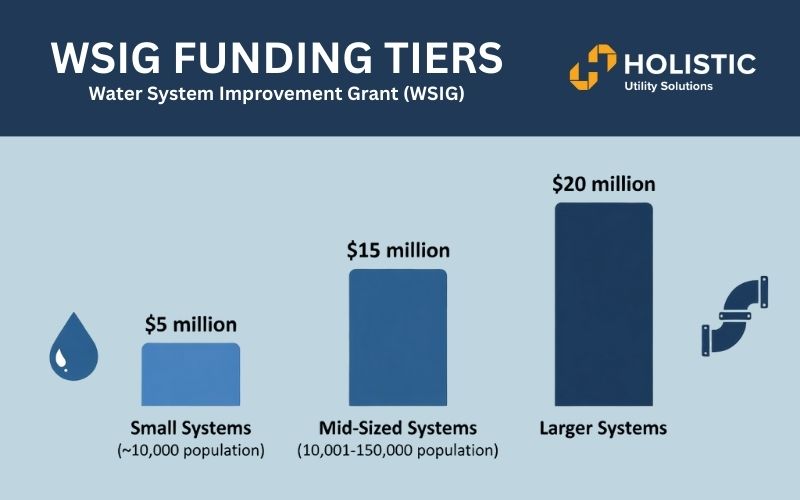
While precise funding caps for individual projects are subject to prioritization, proposed ranges include:
- Small entities (population <10,000): up to ~$5 million
- Mid-sized communities (10,001–150,000): up to ~$15 million
- Larger urban systems: up to ~$25–40 million and beyond (based on need)
How the WSIG Prioritization Works
To ensure funds are deployed where they can have the greatest impact, TWDB proposes a project prioritization framework based on factors such as:
- Annual Median Household Income (AMHI) in service areas
- Service population size and project readiness
- History of never or less-recently receiving TWDB assistance
- Project readiness (e.g., design, permitting, easement secured)
Projects that are “ready to proceed”, meaning engineering and environmental work is complete, generally score higher in prioritization and are more competitive for funding.
How to Apply for WSIG Funding — and How We Help
Applying for WSIG funding is not simply a form submission. Successful applications require clear project definition, strong documentation, and alignment with TWDB prioritization criteria. Many eligible entities will benefit from outside support to move efficiently from concept to award.
Turnkey WSIG Project Development & Grant Support
Holistic Utility Solutions assist cities, counties, districts, and authorities with end-to-end WSIG program support, including:
1. Project Identification & Scoping
We work with your team to identify WSIG-eligible projects that best align with program priorities, funding thresholds, and readiness expectations, whether that’s system rehabilitation, supply expansion, efficiency improvements, or loss reduction initiatives.
2. Readiness & Eligibility Assessment
Before an application is submitted, we evaluate:
- Eligibility under WSIG statutory requirements
- Alignment with the State Water Plan
- Readiness status (engineering, permitting, environmental)
- Financial and operational considerations that affect scoring
3. Grant Application Assistance
We support the full application process, including:
- Application narratives and supporting documentation
- Coordination with engineers, legal counsel, and stakeholders
- Cost development and funding justification
- Compliance affidavits and required certifications
4. Post-Award Program & Project Management
If awarded, we continue to support clients through:
- TWDB contracting and close-out coordination
- Schedule and budget management
- Compliance tracking and reporting
- Owner’s-agent and program management services through construction
Why Engage Early
WSIG is a competitive, one-time funding opportunity with the July 2026 submission deadline just around the corner. Now is the time to get started on your grant application preparation in order to:
- Submit stronger, more defensible applications
- Avoid last-minute engineering and documentation gaps
- Accelerate award execution once funding becomes available
Get Started
We are currently building a WSIG interest list for communities seeking early guidance, application support, or turnkey project delivery.
If your organization is considering WSIG funding, submit an interest form to start the conversation early and position your project for success.
Why WSIG Matters for Texas Communities
Texas water systems face acute challenges, from aging infrastructure to expanding populations and drought risk. The WSIG program represents a significant infusion of state-level capital to support critical water supply projects without the burden of long-term repayment. For many communities, WSIG funding can accelerate capital improvements that improve reliability, reduce losses, and expand access to clean, safe water.
This one-time grant opportunity is distinct from ongoing TWDB programs and offers unprecedented access to direct state funding for communities ready to plan, design, and build lasting water infrastructure solutions.
Looking for guidance on preparing a WSIG application or evaluating project readiness? Our team has created a dedicated WSIG resource for Texas communities considering funding.